PEPTIDE OEM BUYER GUIDE
Peptide Oral Film OEM: Size, Uniformity and Sachet Specifications
Turn an oral strip idea into a reviewable brief with film dimensions, unit-content testing, defined disintegration conditions and an individual-sachet pack.
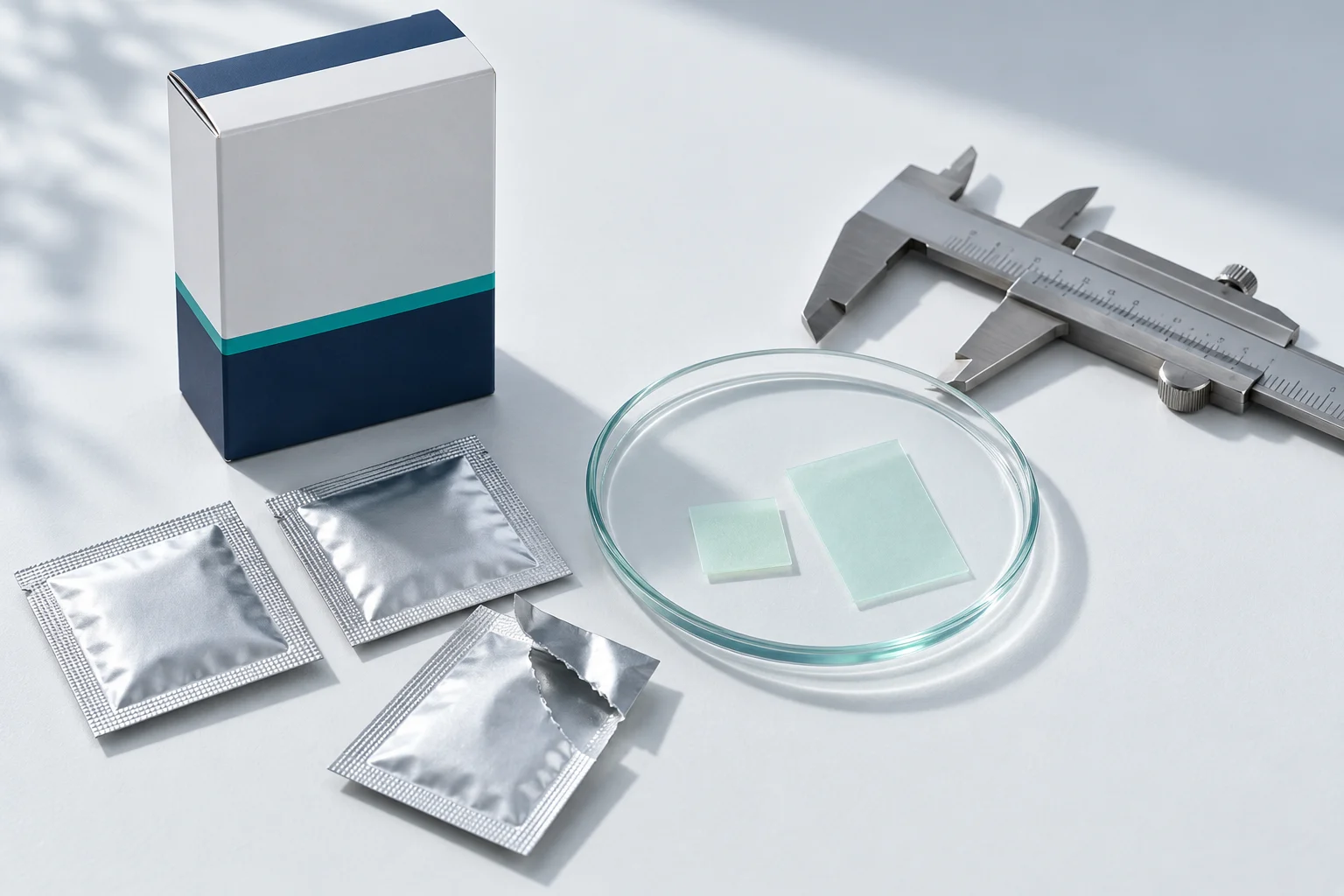
A useful oral-film specification defines what one strip contains, how it behaves under a stated test and how its sachet protects it. Film size alone cannot establish a deliverable peptide amount or absorption. Resolve ingredient suitability and the product’s market classification before treating a packaging prototype as a saleable product.
Confirm the strip dimensions and the saleable unit
PeptidesOEM’s current project brief uses a regular 20 x 20 mm film, with custom dimensions up to 20 x 35 mm for feasibility review, and 20 or 30 individually packed strips per carton. These are project options supplied for this site, not industry standards or guarantees that every formula can use the maximum area. Confirm them in the written quotation.
A 20 x 20 mm strip has an area of 400 mm²; a 20 x 35 mm strip has an area of 700 mm². The larger outline therefore provides 75% more area. That calculation does not establish 75% more usable peptide capacity. Thickness, composition and performance still require development work.
- Film: length, width, thickness range and acceptable edge condition.
- Unit: one film in one sealed sachet, with a defined content specification.
- Carton: 20 or 30 sachets, artwork revision and lot-code location.
- Handling: opening method, film removal and protection before use.
Distinguish disintegration from dissolution and absorption
Record exactly what a test measures. Disintegration describes physical breakup; a dissolution or release method measures material entering the test medium. Neither result alone demonstrates systemic exposure in a person. A film that disappears quickly can still leave unanswered questions about peptide integrity and the route of uptake.
The Japanese Pharmacopoeia XVIII, General Rules for Preparations, section 1-8 addresses oral films, dosage-unit uniformity and dissolution or appropriate disintegration. It also discusses moisture-protective packaging for susceptible preparations. This is a pharmaceutical reference from the 2021 edition, not a blanket standard or authorization for a peptide supplement concept.
Make the test reproducible
Ask the supplier to state the medium, temperature, agitation, endpoint and number of units tested. A video of a strip disappearing in a glass does not provide those details. Keep videos as demonstrations and retain the written test method and results as the acceptance record. Avoid promising a fixed number of seconds unless the approved method and product support it.
Measure content across the film, not just in the mixing vessel
The sampling plan should follow the product through casting or another selected forming process, drying and cutting. Ask how units are selected across positions and production time. A blend result from one vessel does not answer whether every cut unit meets the agreed content requirement.
Specify the analyte and reporting units. Total film weight, peptide ingredient weight and measured peptide content are different quantities. For a development batch, a practical report links each sampled strip to its location or sequence, gives the individual results and explains any excluded sample. Have the technical team justify the final sampling frequency and acceptance limits.
Inspect the removal step
During sample review, check whether the film peels from its liner, remains intact and can be removed from the opened sachet. Record sticking, tearing or fragments left behind. These observations help define usability requirements, but they do not replace an assay or a safety assessment.
Test the film inside the intended sachet
Approve the contact layer, barrier structure and seal design before collecting the evidence that will support storage instructions. Ask for a pouch drawing and a material specification, rather than relying on the phrase “aluminum bag.” A silver appearance does not identify a laminate’s composition or performance.
Include checks for seal contamination, wrinkles through the sealing area and damage during carton assembly. If the supplier changes the laminate or sealing equipment, document whether the existing data remain applicable. Evaluate unopened storage separately from the short handling period after a sachet is opened. The proposed use instructions should match the assessed conditions.
Prepare the first oral-film development brief
Send the exact peptide identity, intended use, destination market, preferred flavor direction, film size and pack count. List any prohibited ingredients or customer requirements. Mark requested content and performance as development targets until supported; avoid presenting them as verified specifications in launch artwork.
The oral-film OEM page covers the format discussion. For a comparison with can-packed products, read the oral-pouch feasibility guide. Once a prototype is accepted, use a controlled sample-to-production handoff so the commercial batch uses the approved film and packaging revisions.
FAQ: buyer questions
What oral-film sizes and pack counts can I discuss?
The site's project brief specifies a regular 20 x 20 mm film, custom dimensions up to 20 x 35 mm for feasibility review, and 20 or 30 individually packed strips per carton. Confirm the final dimensions and formula suitability in the quotation.
Does a fast-dissolving film prove fast peptide absorption?
No. Physical disintegration, release into a test medium and absorption are separate outcomes. An absorption claim needs evidence for the exact peptide, formulation and route.
Can film weight replace a peptide-content test?
No. Film weight includes the film-forming base and other ingredients. Specify a suitable analytical method for the peptide and a sampling plan for individual finished strips.
References and scope
Source check: 31 October 2026. The checklists are editorial procurement recommendations, not company test results. Regulatory sources apply only within their stated scope; confirm current requirements with a qualified reviewer for the intended market.