PEPTIDE OEM BUYER GUIDE
Lyophilized Peptide Powder OEM: Moisture, Vial Closures and Stability
What to specify before approving a freeze-dried peptide vial kit, from residual moisture and closure components to storage evidence and batch release.
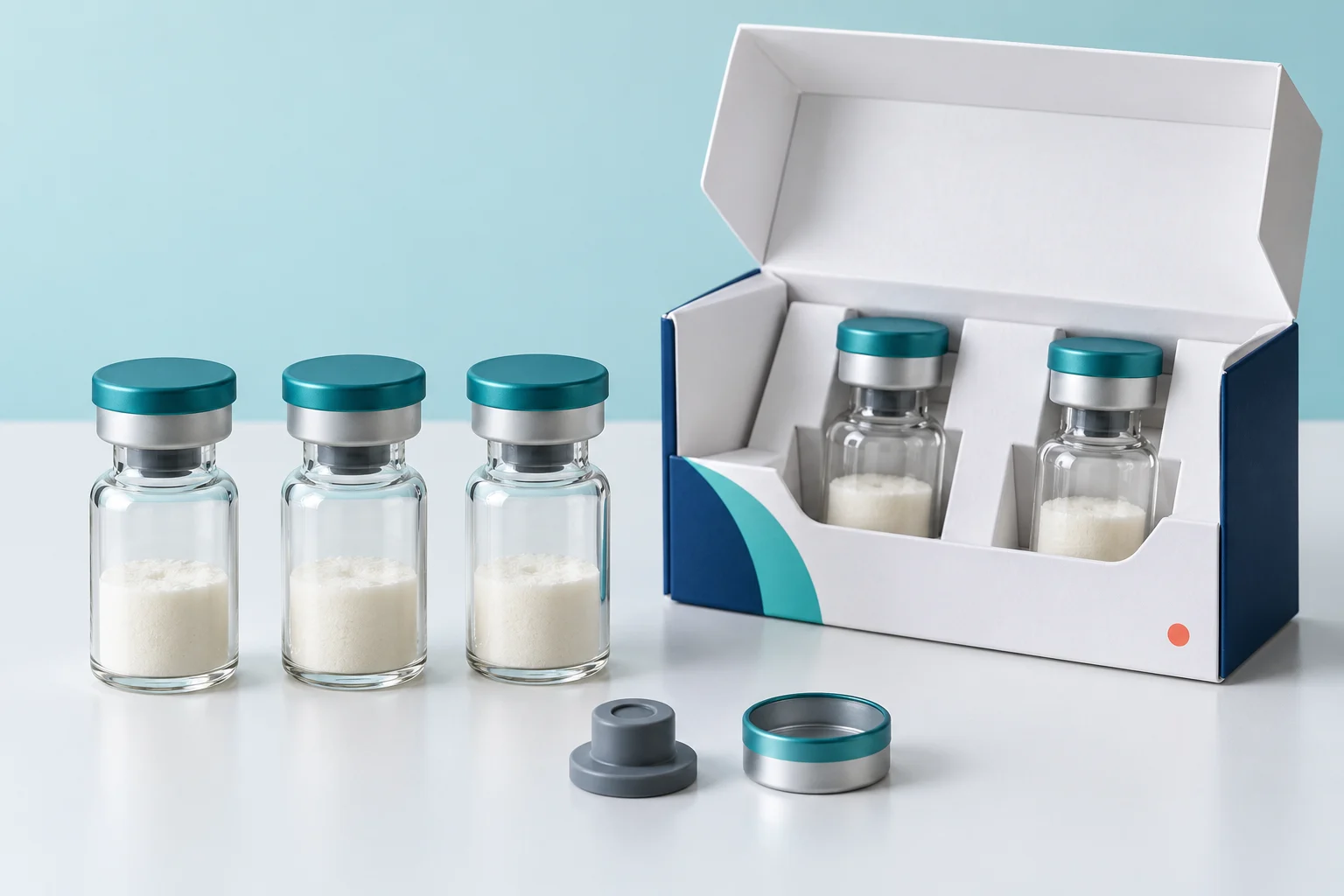
Approve a lyophilized peptide kit against a written specification for the powder, its container and its intended use. A white cake and a sealed cap are useful visual checks, but neither establishes peptide content, shelf life or sterility. Ask for results from the actual formula and vial system before agreeing to storage language or a commercial release.
What freeze-drying changes
Freeze-drying removes water from a frozen formulation under reduced pressure. FDA’s historical lyophilization inspection guide distinguishes freezing, primary drying and secondary drying. The document concerns parenteral drug manufacture; it is technical background, not a certification of a cosmetic vial or of this website’s products.
For an OEM inquiry, separate the requested peptide from the full dried formulation. Excipients contribute to the cake and its handling properties. A vial containing a stated total mass of powder does not necessarily contain that mass of peptide. Require the quotation and specification to state which quantity they describe, including the basis used for any assay calculation.
Start with the intended-use boundary
A cosmetic ingredient, a research material and an injectable medicine require different assessments. A research-only designation does not authorize consumer use. A cosmetic-grade powder is not suitable for injection merely because it comes in a familiar glass vial. Define the lawful intended use and destination market before choosing a manufacturing route.
Write measurable acceptance criteria
Ask the development team to propose limits with a rationale. Copying a residual-moisture target from a different peptide can create a specification that looks precise but has no relationship to the proposed product. The analytical method, sampling plan and stage of testing must accompany each limit. Use a controlled reference sample for appearance, while retaining numerical tests for attributes that cannot be judged by eye.
- Identity and peptide content: named method, reporting basis and acceptance range.
- Residual moisture: method, sample handling and justified limit.
- Appearance: cake shape, color and defined rejection examples.
- Container: vial, stopper and cap component codes, with approved suppliers.
- Microbiological requirements: appropriate to the product classification and intended use.
- Batch records: lot linkage, deviations and the person authorized to release the batch.
Evaluate the vial as a complete system
The closure review should cover the vial neck, elastomer stopper, crimp and handling conditions together. A component substitution deserves review even when the replacement has the same nominal dimensions. Ask what changed, what comparison was performed and whether existing stability evidence still applies. Keep the component drawing and material identification with the approved bill of materials.
FDA’s August 2026 container-closure guidance is a draft for human drugs and biological products, explicitly not for implementation. It is useful context for packaging evaluation, but should not be described as a final cosmetic standard. For this buying decision, request evidence appropriate to the actual product instead of adding a generic regulatory badge.
Check what the carton protects
A retail carton may protect a label and hold vials apart. It does not establish the moisture barrier of the primary closure. Include the insert, vial spacing and shipping case in pack-out trials. Record damage, cap movement and label abrasion after the agreed handling test. A decorative sample box is insufficient for this approval.
Ask for stability evidence in the proposed pack
A useful stability summary identifies the batch, formula revision, pack components, storage conditions, time points and methods. Request both initial results and subsequent measurements. Where a result changes, ask how that change affects the proposed specification. Do not accept an expiry statement based only on an ingredient supplier’s retest date.
Storage instructions must come from the product-specific assessment. There is no universal temperature or shelf life for every peptide powder. If a cosmetic kit is intended to be mixed before use, the mixed product needs its own handling and safety assessment; unopened-vial data do not establish a period of use after mixing. This guide does not provide reconstitution or administration instructions.
Build a quotation that can be compared
Send one brief to each shortlisted supplier. Specify whether the project covers ingredient supply, vial filling, a finished cosmetic kit or a regulated development route. Request separate costs for development, testing, primary containers, printed components and final assembly. Identify which costs recur and which belong to an initial qualification exercise.
For lyophilized peptide powder OEM, include the intended pack count and the evidence needed before approval. Use the COA checklist for ingredient-document review, then agree the finished-kit specification separately. The sample-to-production checklist explains how to control later changes.
FAQ: buyer questions
Does freeze-drying make a peptide vial sterile?
No. Freeze-drying is not a substitute for a validated sterility-assurance strategy. The manufacturing route and testing must fit the product classification; a cosmetic or research vial must not be treated as an injectable medicine.
What residual-moisture limit should I request?
Request a product-specific limit supported by the formulation and stability assessment, together with the analytical method and sampling plan. There is no single suitable limit for every peptide formulation.
Can I change the stopper after approving a sample?
Treat the replacement as a controlled change. Review its material, dimensions, compatibility and effect on existing stability or closure evidence before authorizing production.
References and scope
Source check: 31 October 2026. The checklists are editorial procurement recommendations, not company test results. Regulatory sources apply only within their stated scope; confirm current requirements with a qualified reviewer for the intended market.