PEPTIDE OEM BUYER GUIDE
Peptide Oral Pouches: What an OEM Feasibility Review Must Establish
Separate pouch packaging from peptide-delivery evidence, then define ingredient eligibility, release testing, tolerability and the data needed for a go/no-go decision.
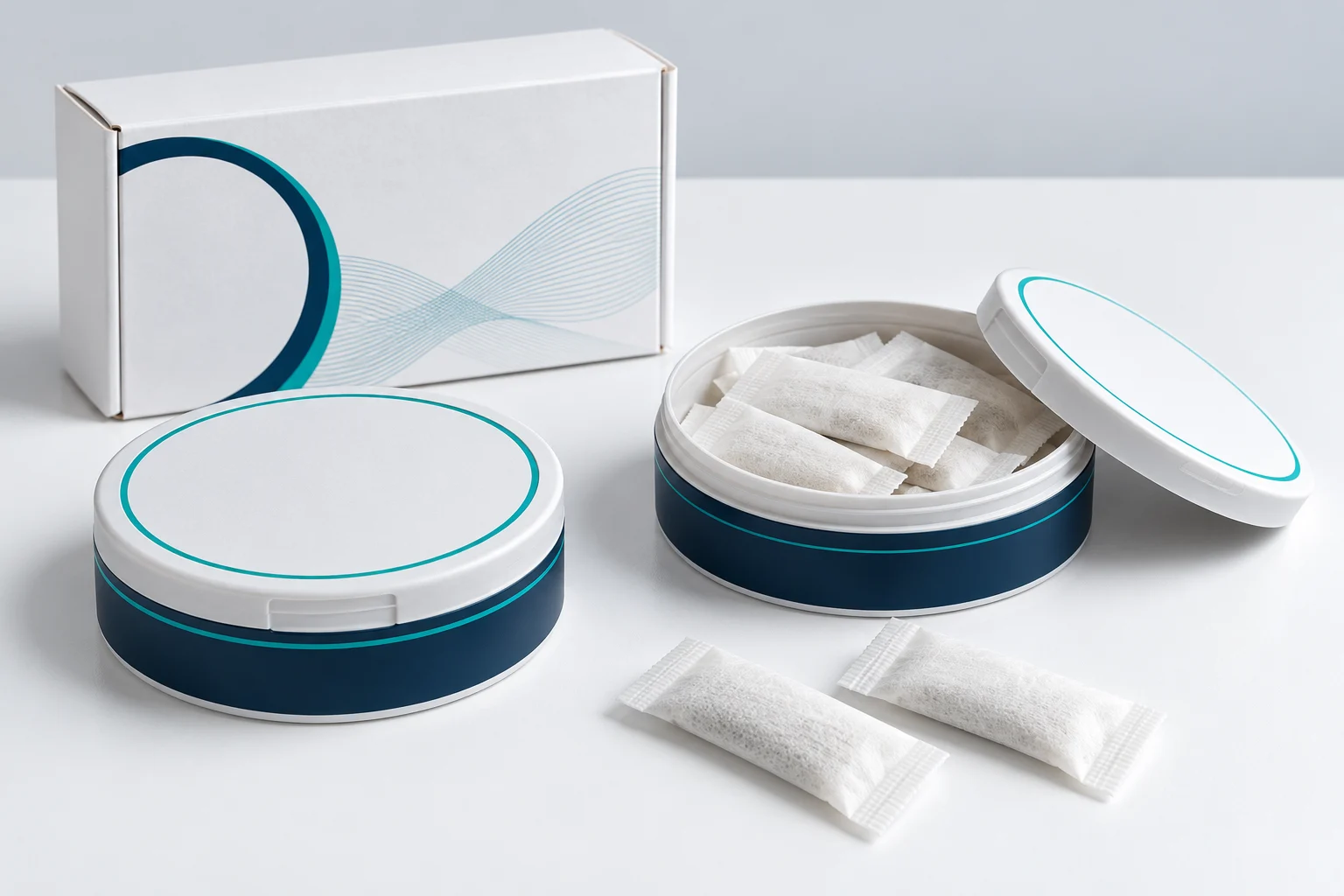
Treat a peptide oral pouch as a development proposal until its ingredient, intended use and supporting evidence have been reviewed. A familiar pocket-sized can can make the format easy to recognize. It cannot establish lawful sale, mucosal absorption or equivalence to an approved medicine. Set a go/no-go review before ordering printed cans.
Define the peptide and the proposed route
“Peptide” identifies a broad class of molecules. An inquiry needs the exact identity, composition, source and specification of the proposed ingredient. Include the reason for using a pouch, how the product is intended to be used and the country of sale. Keep the ingredient specification separate from the consumer claim.
Ask a qualified reviewer to determine the relevant product classification. For a proposed US dietary supplement, ingredient eligibility and any new dietary ingredient obligations need examination. FDA’s NDI notification process concerns identity and safety information for qualifying ingredients and conditions of use. It does not establish that an arbitrary peptide pouch is eligible to be sold as a supplement.
Record a decision before formulation spending
The brief should name who owns the regulatory assessment and what evidence would stop the project. An unresolved ingredient-status question is a reason to hold consumer artwork and launch commitments. A supplier’s willingness to manufacture a sample is a separate commercial fact.
Keep release, permeation and human exposure separate
A release study can show how much of the measured substance leaves a pouch under specified laboratory conditions. A permeation experiment addresses movement across its chosen test barrier. Human pharmacokinetic evidence addresses exposure in people. Results from these different studies answer different questions, and the test model must be identified whenever a percentage is reported.
For a useful illustration of formulation specificity, the 2024 FDA Rybelsus label, section 12.3 reported estimated absolute bioavailability of approximately 0.4% to 1% for its R1 oral tablet formulation. That approved drug uses a specific absorption-enhancing formulation and is absorbed predominantly in the stomach. These data do not predict the performance of a buccal pouch, and are not a recommendation to put semaglutide into a consumer pouch.
Turn a can concept into a testable specification
Begin the packaging brief with the pouch itself. The fill, nonwoven material and seam all affect what must be evaluated. The can adds its own questions about closure, storage and repeated opening. Keep the planned number of pouches per can explicit so that a sample review uses the same pack configuration as the proposed commercial product.
- Ingredient identity and content target, with the basis of calculation.
- Pouch dimensions, fill mass and material identification.
- Seam integrity and acceptable loose-particle limits.
- Moisture-related measurements selected for the formulation.
- Can and closure component codes, pack count and lot coding.
- Defined release-test conditions and analytical recovery checks.
- A safety-review plan for the intended oral contact and use conditions.
Do not borrow nicotine-product assumptions
Existing pouch brands are useful references for pocket size, lid handling and retail presentation. Their formulations, exposure data and legal status do not establish the suitability of a peptide. Develop an original pack identity, and assess the proposed contents on their own evidence.
Specify the evidence needed to proceed
Agree a short written development plan before sampling. It should connect each question to a test, an owner and a decision. A packaging mockup may be approved for appearance while ingredient feasibility remains unresolved; record those as separate approvals. Avoid a general “sample approved” email that obscures what was actually assessed.
Request results that identify the exact formulation revision, pouch lot, can components and storage history. A report should explain the sampling method, individual observations and deviations. Where the study is exploratory, label it exploratory. Do not convert a small bench experiment into a clinical claim or a fixed commercial shelf life.
Choose the next step from the evidence
A project may proceed to a controlled pilot, return for reformulation or stop because an essential requirement cannot be supported. Make that outcome explicit. If the intended benefit depends on systemic peptide delivery, unresolved exposure evidence is a central development issue, even when the packaging is ready.
Use the Peptide Oral Pouches project page for format and packaging discussions. The oral-film specification guide covers a different oral format without assuming equivalent delivery. Send the ingredient and market brief through Start Your Project; a project discussion is not a declaration that a proposed peptide is approved for consumer use.
FAQ: buyer questions
Does a nicotine-free pouch automatically qualify as a dietary supplement?
No. Classification depends on the ingredient, intended use, claims and destination-market rules. Removing nicotine does not establish ingredient eligibility or product safety.
Can oral tablet absorption data support a peptide pouch claim?
Not by themselves. The molecule, formulation, route and test conditions must match the claim being made. Data for an approved oral tablet cannot establish absorption from a different pouch formulation.
What should be supplied before requesting a pouch prototype?
Provide the exact ingredient identity, intended use, market, proposed content, pouch and can preferences, planned claims and available safety or performance evidence. Identify unresolved questions before approving consumer artwork.
References and scope
Source check: 31 October 2026. The checklists are editorial procurement recommendations, not company test results. Regulatory sources apply only within their stated scope; confirm current requirements with a qualified reviewer for the intended market.